
Because Cities Deserve Healing Too
Urban development is often rushed, fragmented, or driven by unchecked ambition. What results is a city that functions but doesn’t flourish—where infrastructure outpaces identity, and where innovation ignores inclusion.
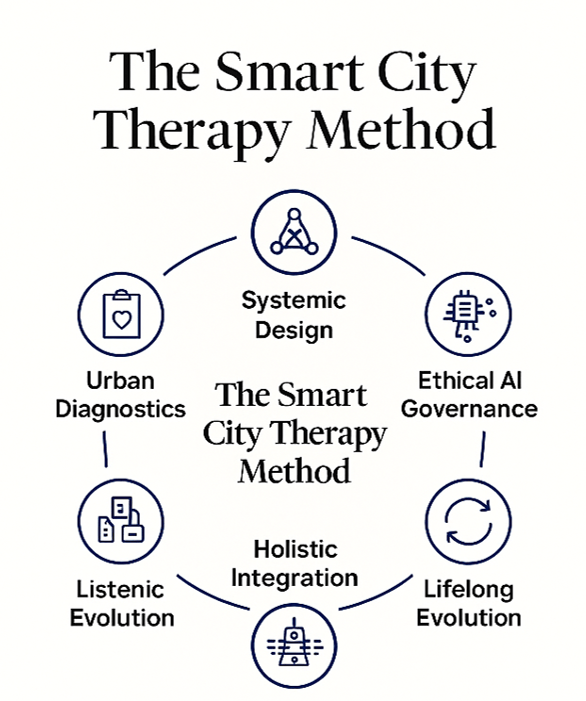
Smart City Therapy™ is a diagnostic and transformation framework pioneered by Dr. Houssam Al Masri. It is rooted in the belief that cities are living ecosystems—they carry trauma, memory, culture, and potential. To unlock their true power, they must be understood, aligned, and healed.
Urban Diagnosis
“Listen to the city before trying to fix it.”
We start with the soul of the city. Through deep listening and forensic spatial analysis, we uncover:
- Latent urban trauma (displacement, disconnection, dysfunction)
- Systemic misalignments (mobility vs. land use, tech vs. need)
- Invisible barriers to inclusion, sustainability, and wellbeing
Our toolkit blends community empathy mapping, digital twin analytics, and ISO 37100-based gap assessments to reveal where the city hurts—and where it wants to grow.
Systemic Design
“Design cities like living systems.”
Solutions are framed within the whole urban ecosystem—connecting transport, utilities, buildings, and digital services into adaptive, synergistic systems. This avoids fragmented planning and enables city-wide resilience.
Ethical AI Governance
“Technology with a conscience.”
AI and data-driven services are implemented with transparency, inclusivity, and fairness. Governance frameworks ensure that digital tools empower citizens without infringing on rights or introducing bias.
Holistic Integration
“Weave infrastructure, ESG, and digital into one urban fabric.”
Smart systems are integrated across physical, environmental, and digital layers. This includes seamless ESG alignment, cross-sector coordination, and interoperable platforms to future-proof city services.
Lifelong Evolution
“Cities should keep learning, not just expanding.”
Urban development is treated as a continuous process. The method embraces iteration, adaptability, and feedback loops—encouraging constant refinement of policies, platforms, and services.
Listenic Evolution
“Cities must listen to citizens—and evolve with them.”
Inspired by therapeutic models, this principle embeds urban empathy. It calls for participatory design, citizen co-creation, and the inclusion of vulnerable voices in shaping the city’s future.
